Der Essay Tracing Threads of Time and Space in Conceptual Fashion Design in Lagos untersucht die Rolle konzeptueller Mode bei der Formierung neuer postkolonialer Identitäten in Lagos, Nigerias pulsierender Wirtschaftsmetropole und wichtigem Modezentrum auf dem afrikanischen Kontinent. Versteht man mit Hildi Hendrickson den Körper als “a principal site of social and political action”, so erfordert dies zugleich eine Anerkennung der sozialen und politischen Implikationen von Kleidung und somit ihrer Fähigkeit, gesellschaftlichen Wandel nicht nur anzuzeigen, sondern auch mitzugestalten. Anhand der Modelabels Lagos Space Programme, Iamisigo und Maxivive wird der Frage nachgegangen, wie Mode zum Kommunikationsmedium und Banner einer soziokulturellen Agenda wird.
Was die Labels verbindet, ist eine konzeptuelle Herangehensweise an Mode, bei der die Materialität eine wichtige Rolle übernimmt: Materialien und Formen werden zum Träger kultureller Referenzen ebenso wie habitueller, ästhetischer und symbolischer Wissensbestände, über die sich aktuelle Diskurse verhandeln und neue (materielle) Narrative schaffen lassen, um gesellschaftliche Grenzen zu verschieben und bestehende Normen neu zu kodieren.
Die sartorialen Strategien, die hier zum Einsatz kommen – die Neuverhandlung lokaler Textiltraditionen, Kulturtechniken und Wissenssysteme – können dabei als zeitgenössische künstlerische Form von afrikanisch inspiriertem Zukunftsdenken verstanden werden.
The essay Tracing Threads of Time and Space in Conceptual Fashion Design in Lagos examines the role of conceptual fashion in the formation of new postcolonial identities in Lagos, Nigeria’s vivid economic metropolis and one of Africa’s fashion capitals. Understanding the body as “a principal site of social and political action” (Hendrickson 1996:3) means acknowledging the social and political implications of dress and thus its ability to both indicate and shape societal change.
With a focus on the fashion labels Lagos Space Programme, Iamisigo and Maxivive, this paper examines how fashion becomes a communication medium and banner of a socio-cultural agenda.
What unites their work is a conceptual approach to fashion with materiality playing a major role: Materials and forms become carriers of cultural references as well as habitual, aesthetic and symbolic knowledge, serving to negotiate current discourses and create new (material) narratives, allowing social boundaries to be shifted and existing norms to be recoded.
The sartorial strategies applied – the renegotiation of local textile traditions, cultural techniques and knowledge systems – can be understood as contemporary artistic practice of African-inspired future thinking.
Der Essay entstand im Rahmen des DFG-Forschungsprojekts “Fashion and Styles in African Cities” (unter der Leitung von Prof. Dr. Kerstin Pinther) und basiert auf Forschung vor Ort in Nigeria. //
The essay was written as part of the DFG (German Research Foundation) research project “Fashion and Styles in African Cities” (under the direction of Prof. Dr. Kerstin Pinther) and is based on fieldwork in Nigeria.
Erschienen in // Published in:
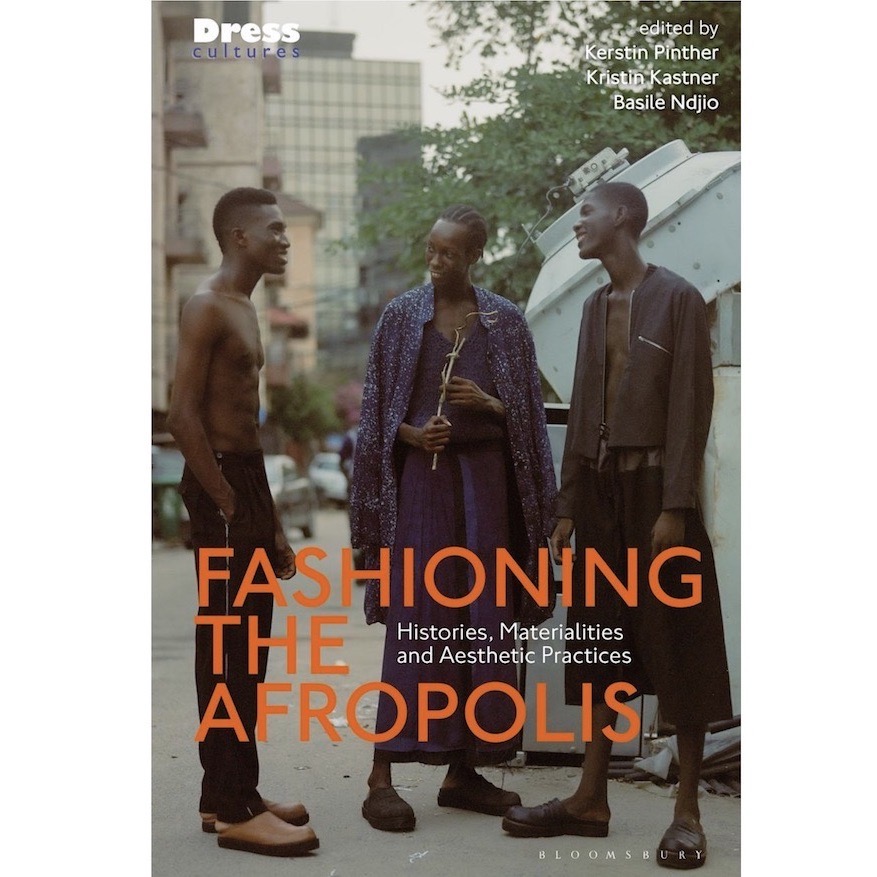
Pinther, Kerstin, Kristin Kastner & Basile Ndjio (Eds.). Fashioning the Afropolis: Histories, Materialities and Aesthetic Practices. London: Bloomsbury, 2022.
https://www.bloomsbury.com/us/fashioning-the-afropolis-9781350179523